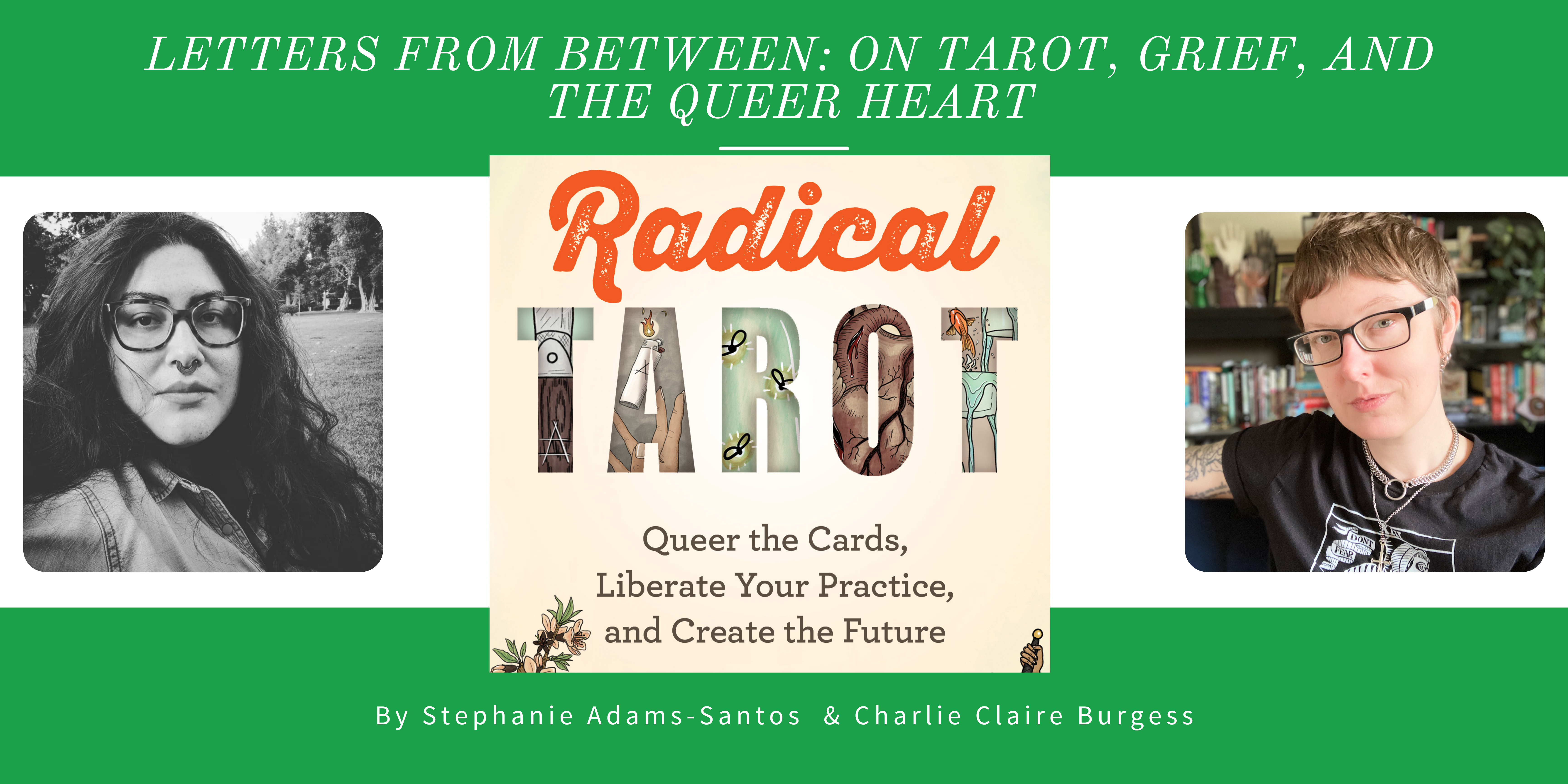

Stephanie Adams-Santos and Charlie Claire Burgess
Letters have a long, queer history. They are often the site of private discoveries and vulnerable expression, quiet confrontations with self and other, fanciful musings and dreamings—possibilities. We bring things to letters we have been privately exploring in the murkiness of half-thought so that we may simultaneously discover and divulge what’s inside us. Letters are objects of interiority and points of tender connection, reaching across the spaces between us.
But tarot (like life, art, and queerness) is not predictable.
This epistolary project was meant to explore the intersections of tarot, writing, and queerness, exchanged between two friends. But tarot (like life, art, and queerness) is not predictable. The cards slip meaning off their shoulders like a selkie slips off her human skin. One question is asked, and a different one answered. The reading shapeshifts, shimmering between stories, tempting the que(e)rent toward reckoning and revelation.
Perhaps accordingly, our letters about tarot, writing, and queerness also ended up being about grief, love, justice, and what it will take to create another world. These letters were written in November 2023 and are therefore inextricably veined by Israel’s genocidal campaign in Gaza. After all, queer liberation and Palestinian liberation are linked, as are all freedom struggles of the marginalized and oppressed. And as any tarot reader will tell you, the cards won’t let you ignore what most needs to be addressed.
Reading a poem, a novel, or a tarot spread is an act of dreaming.
Reading a poem, a novel, or a tarot spread is an act of dreaming. We enter briefly into other worlds where we may dance for a moment with strange and necessary spirits, where we may touch the secret creatures of our hearts, where we may imagine queer new futures into being. Writing a poem or novel or interpreting a tarot spread is an act of revelation, of reaching into that other world and pulling it into this one for a little while, to steep in it, to try it on.
To engage with poetry, prose, or tarot is to open ourselves to be changed. We need this alchemy now more than ever. Our hope is that reading these letters may stir the transformation that is brewing in you now, even as you read these words.
* * *
November 8, 2023
Dear Stephanie,
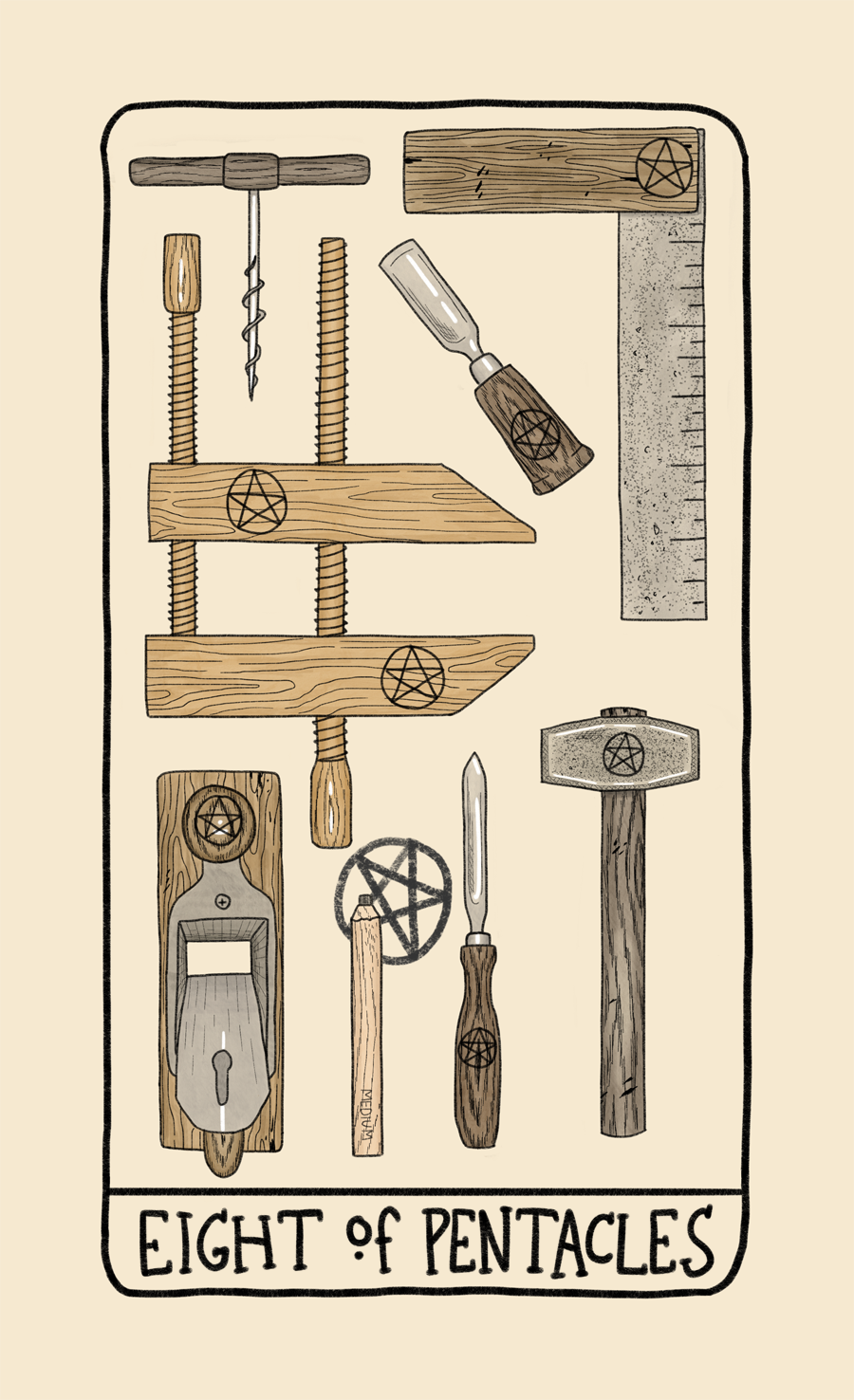
I drew the 8 of Pentacles for you today. It’s funny because (as you know) I pulled it earlier today, too, in a reading I did about this correspondence of ours. The question I asked then was, basically, “What should we do?”
We originally planned to begin these letters together in October once I got to the other side of my book release. But then the tragedies of October 7th happened. Then, the skin of the world was pulled away like a veil, and all the bloody machinery of colonization exposed. (We knew the machine was there, you and I, but I think especially you.) Writing this essay was trivial. Pulling tarot cards was trivial. What can we do in the face of such horrors? Horrors I myself have been complicit in as an American and a settler? Where do we go? What do we do?
The 8 of Pentacles means work.
When I pulled the card earlier today, in my question about this essay (Do we even do it? Do we move forward? Do we try?), it said, get to work. This is a card about refining skills and honing the craft. It’s about persistence, labor, sweat. So, I texted you, and you said, “I think we try.”
When I shuffled just now to pull the first card to start this epistolary experiment, I again drew the 8 of Pentacles.
What do we do? We work.
But not just plain old work—good work. We do quality work, meaningful work. We sink into the pleasure of the craft. We remember that every detail, each comma, and every small thing matters. The small things are the matter, the clay, the substance that builds meaning and shapes the world. We dedicate ourselves to the work because we love it, or if we do not love the work, we love what we’re working for.
It’s love that keeps us showing up, I think. It’s love that prevents us from absconding into the thin safeties of ignorance and the status quo. Indeed, love makes it unthinkable! (Imagine: getting an office job instead of writing poetry. Assimilating into the cis-het overculture. Ignoring a genocide playing 24/7 through our phones.) As you know, as we know, although the work may indeed be hard, it isn’t hard to do the work if the work is rooted in love. The hard thing, the monstrous, unthinkable thing, would be abandoning it.
So, we work.
I drew this card from my deck, Fifth Spirit Tarot. In it, I illustrated the 8 of Pentacles as eight tools—woodworking tools, mostly, and a pencil. These tools reminded me of two things:
- We are building the world, each of us, every day. We may not have been the carpenters of the house we’re currently living in—the house of colonialism, racism, antisemitism, islamophobia, transphobia, homophobia—but we are its caretakers now. It’s up to us to preserve it or demolish it.
- As Audre Lorde wrote, “the master’s tools will never dismantle the master’s house.” We must use different tools, you and I. All of us. Maybe some of those tools are poetry, tarot, and art. Maybe they’re silly little essays like this. Maybe with these tools—alongside direct action, protests, calls, letters, vigils, blocking boats; alongside conversation, solidarity, helping each other, sharing, witnessing, loving—we can do good work.
Maybe they’re not just tools; they’re keys.
Working,
Charlie
* * *
November 10, 2023
Dear Charlie,
My chest has been a tight fist all month; my heart wrapped around an ember. Like something at my center is slowly burning alive. I know you feel it, too. 4500 Palestinian children are dead at the time I’m writing this letter to you, and god knows how many more by the time these letters are published. It hurts to follow these thoughts, these numbers, these facts into the heartspace, into deep, shuddering feeling. But we must. We must.
This month has been a brutal forging of the spirit and the most radical summons of love I have ever experienced — for love is the root of grief. Love is the root of our purpose on earth. Love is the root of the work you so beautifully elucidated from the 8 of Pentacles — the love keeps us showing up. Thank you for drawing that card for me, for us. As queer energy workers and artists, we understand that this moment impacts the essential nature of our work going forward. It takes us down to the very bone of our purpose and calls us to the deep soul-work, the alchemy, and the moral clarity that the world demands of us.
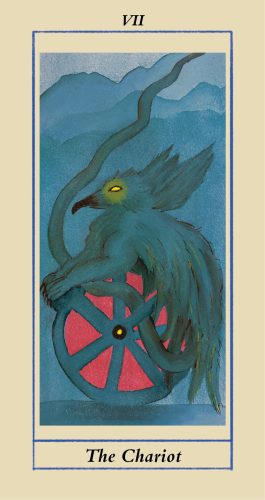
For you, for me, for us, I drew The Chariot.
The Chariot is action rooted in the will of the soul.
I am reminded of song lyrics from Neptune Frost, Saul William’s afro-futurist non-binary masterpiece about a group of escaped Coltan miners who form a collective of anti-capitalist hackers and dreamers:
Picture a dream and dare to live it.
Open your soul and dare to give it
As a child of the 80s, I remember well the days before internet, before cell phones. I remember rotary phones and public pay phones. I remember, too, stories of my mom’s early childhood in Guatemala, without electricity — meals cooked by fire, homes lit at night by candles. All this wasn’t so long ago, not really at all. In the not-too-distant past, the technological advances we now take for granted sounded like science fiction. Yet here they are. I bring this up as a reminder that things that feel inconceivable, impossible even, can become very real very fast. So, if we can dream up internet and cell phones and rockets that go to the moon and colonies on Mars, why can’t we dream of a world where one person’s comfort isn’t built on the exploitation of another? What if, instead of dismissing this notion as a fairytale, we collectively invested in the imaginative labor and joy of dreaming up a world where compassion, justice, and shared well-being are the great technologies of our existence?
The Chariot urges us to act with emboldened imagination. It challenges us to redefine what’s possible and encourages confidence in our actions. This card invites us to be unafraid in our work, to be bold in imagining the future.
Over years and decades, the sum of these efforts creates the shape of one’s life and, collectively, the shape of our world.
I envision the 8 of Pentacles you drew in your last letter as the wheels that propel The Chariot forward. Our daily efforts (no matter how small and imperfect) — be it attending a protest, sharing a post that amplifies the work of a journalist, drafting a poem, calling our reps, volunteering, donating, boycotting, speaking up to friends and family, rethinking our desires, rethinking our careers, lighting our altars with the fire in our hearts, in daring to live toward our dreams — are seemingly small actions that amass into a potent force over time, coalescing into something much greater than the sum of its parts. Over years and decades, the sum of these efforts creates the shape of one’s life and, collectively, the shape of our world. In the words of Ursula Le Guin: “You cannot buy the revolution. You cannot make the revolution. You can only be the revolution. It is in your spirit, or it is nowhere.
In daring,
Steph
* * *
November 15, 2023
Dear Steph,
As I write this, it is Transgender Awareness Week. Being a trans and nonbinary person all 365 days a year, I’m always caught off-guard when these weeks come around. I feel like I’m supposed to put on a little top hat, do a little vaudeville dance like that frog from Looney Tunes—Be aware of me! I’m trans!—and then slip meekly back into my shoebox come Monday.
It’s especially strange this week. Today, I saw a photo of an Israeli soldier standing in the rubble of Gaza, brandishing a Pride flag with a smile on his face. As if bombing and bulldozing Gazan communities—communities where real queer people do live, or used to before they were bombed to dust—is somehow an LGBTQ victory. I’ve had Zionists come into my comments and DMs to tell me that Hamas would kill me for who I am, and in the next breath, they tell me they hope I go to Gaza and find out what happens. They seem to be unaware, or at least unconcerned, of the violent queerphobia of that sentiment.
I don’t want a future where Pride flags wave over war zones.
I don’t want a future where Pride flags wave over war zones. I don’t want a future where my liberation depends on the oppression of anyone. There is no safety bought in blood.
Your letter about dreaming of different futures was a balm to my tired heart. It brought the revolutionary worlds of so many queer visionaries to mind: José Esteban Muñoz’s queer utopia always on the horizon, adrienne maree brown’s emergent strategies, Gloria Anzaldúa’s borderlands where binaries and categories are mixed and defied, where previously unthinkable divergent possibilities are born. As I shuffled the cards, I asked for a card for possibilities, a card for enacting new worlds—more liberated, connected, queer worlds—together.
I drew the Hermit.
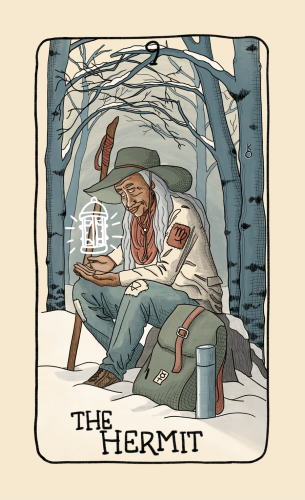
I admit that I was dismayed by this card at first. I asked a question for collective liberation, and I drew a card about solitude and exile. Where is my card about solidarity, community, revolution? Will we come together only to become fractured once again?
Then I remembered: the Hermit is the archetypal rebel.
A hermit shuns society to follow the lantern light of their truth. They hide in the swamp to aid the rebel fighters. They appear in the woods with cryptic answers to the hero’s questions, chuckling all the way. They live on a weird, communal farm with their queer polycule, conscientiously objecting to paying the war tax. The hermit is the willful outsider, the outlaw philosopher, the public menace, the mystic meeting God in a cave. The hermit leaves the machine noise of the city to better hear their own soul’s song.
The Hermit invites us to leave the supposed safety of the accepted and the acceptable. They invite us to step outside the city walls of capitalist desperation and imagine—no, experience—other ways of being, other worlds. The Hermit beckons us to the woods, the wilds, the borders, and in-between places where other-dreaming is potent and emerging lush and hungry through the cracks in every wall.
I think of what Gloria Anzaldúa wrote of the borderlands:
“A borderland is a vague and undetermined place created by the emotional residue of an unnatural boundary. It is in a constant state of transition. The prohibited and forbidden are its inhabitants. Los atravesados live here: the squint-eyed, the perverse, the queer, the troublesome, the mongrel, the mulato, the half-breed, the half dead; in short, those who cross over, pass over, or go through the confines of the ‘normal.'”
Crossing borders is a particularly queer thing.
Crossing borders is a particularly queer thing. Whether it’s “illegally” entering a country or transitioning genders, border-crossing is revolutionary. Border-crossing threatens the State and the institutions of power because it proves their arbitrary boundaries a lie. (This is why Israel walled Gaza in. This is why the U.S. continues to build the border wall even with Democrats in power. This is why governments throw people—children—in prison, in cages: because borders of iron are harder to cross.)
Border-crossing is world-ending and world-building. Border-crossing requires a consciousness that can see through the borders (because they do not exist) and can see beyond them to another world, another future. Border-crossing means leaving a known and codified place for an unknown and queered “Other” place that is not guaranteed.
The Hermit is the border-crosser. And though they may undertake a solitary journey on their unknown path, the Hermit is not alone. Or, not for long.
A poem came across my screen today from the Divine Algorithm, I suppose. Feminist anarchist poet Diane di Prima’s “Revolutionary Letter #29” describes revolutionary brothers and sisters in the hills and jungles and tundra, singing around fires, arming, multiplying:
nowhere can we go but they are waiting for us
no exile where we will not hear welcome home
‘good morning brother, let me work with you
good morning sister, let me
fight by your side’
The Hermit reminds us that solidarity is a solitary choice that must be made individually from the untamed wilderness of one’s heart, knitted like roots into the soul. And solidarity is a choice for connection, a connection deeper and stronger than any tepid societal approval, a connection entangled and supported as roots are, gnarled tender hands holding one another underground.
So let us go outside even though we are afraid. Let us find our way through the hills. Let us hack our way down the untraveled path and forget the city walls in the shadows of the leaves. Let us cross over to the campfire where our companions wait.
Let me fight by your side. Good morning.
Crossing,
Charlie
* * *
November 25, 2023
Dear Charlie,
Today, I write to you from rural Vermont, where I look out on the snow-dusted pine and birch forest surrounding my cabin, and I’m grateful for your words. I look out into this wilderness of fishers and black bears, ermines and grouse, and I’m grateful for the wisdom that reaches me here. Your words are stirring deeply — Let us find our way through the hills. Let us find our way.
Thank you for bringing The Hermit into my thoughts today. The Hermit — that wise, mysterious figure who first drew me to the Tarot as a lonesome teen coming into my queerness, into the jungles of my Self. I love your articulation of The Hermit’s invitation to not only imagine but to experience “other ways of being, other worlds,” ways of being that have not (yet) been codified into society. That’s so important.
I’m thinking too of the Hermit’s lantern in your image, its warmth summoned from heart, imagination, or God, or all three. However far away in the hills The Hermit might be, however alone, their spirit-lantern is both a private and communal light. Their quiet, inner work becomes another star in the darkness by which others may navigate through the wilderness.
Today, I’m feeling the wilderness acutely.
Today, I’m feeling the wilderness acutely. Where do I go from here? Where do We go from here? With our broken hearts, with this unrelenting grief, with our fears and our dreams — where do we go?
And so, I turn to the Tarot with this question, and I draw —
The Fool.
I can’t help but think now about the sacred connections between The Fool and The Hermit — how much the latter seems the elder version of the former, all grown up, like Blake’s famous lines: “if the fool would persist in his folly he would become wise.”
The Fool and their elder counterpart, the Hermit, know something surely about surrender, steadfastness to one’s spiritual journey, faith, and courage. If ever there was one to leave Omelas[1], it would be the Fool — stumbling away from that place with no other safety net than the assurance in their heart that they must do what is right. And years later, it would be The Hermit to tell us the tale, sending their dispatch from the distant mountain— The Fool grown wise.
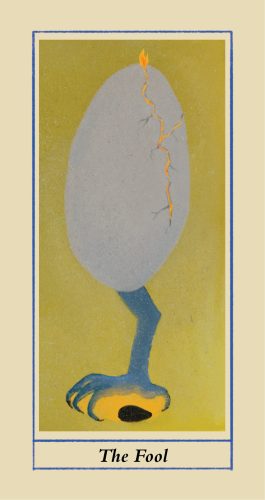
The Fool risks the safety of the well-tread path, stepping off the ledge of their comforts in faith of a greater truth. They take the wild leap of heart. They embrace risk in a way that others fear. They risk it all in the name of freedom, a reckless courage that grants The Fool the ability to speak truth in the face of silence. I think about the current blacklisting in Hollywood, Western journalism, and across many industries — the pressure to remain silent or neutral about genocide for fear of losing one’s career. In a world of double-speak, where the call for a ceasefire can be twisted to mean the opposite of what it stands for, the Fool urges us to defy the vast pressure to conform to the narratives of those in power. The Fool rejects any authority beyond the Divine, with a mystical understanding that transgression is essential to pursuing a spiritual path. The Fool says so what if you threaten me? Take away my job, then! Rescind my award. Uninvite me from the gala. Arrest me, call me names, blacklist me, ridicule me, go ahead — I know my truth; I will wear it on my sleeves, I will sing it proudly, and I will die singing my song. The Fool teaches us that what is most essential to the spirit can never be taken away.
The Fool, whose earthly possessions are carried in a sack, brings to mind the images of refugees marching away from their bomb-blasted homes with all that they can hold. In the face of unthinkable loss, they make do with only fragments. They go on. They praise God. They continue to love. They keep the keys of their stolen homes around their necks. They say, “We will be free.” They who have lost everything reveal what is eternal.
The Fool is hardly a haggard figure. They wear bells, bright colors, head held high, limbs poised with vitality. The Fool dances before the king with a freedom the king may outwardly mock yet secretly envy. The figure in my own Fool card is a freshly-hatching creature grasping the shining kernel of life’s mystery.
There are recent videos I watch over and over: Palestinian children laughing and playing in the ruins of war. Here is the indomitable spirit of life, innocent and playful and spry. Here is the unlikely joy that surges from the depths of darkness like the fragile green sprout of a flower planted in an empty tear gas canister. I’m sure you’ve seen the video of the Palestinian wedding taking place between the bombings of Gaza. Miraculously — there is dancing!
A young Ocean Vuong once wrote: “Ask me of the dancers, and I will tell /of the fools who kept dancing, even/ as the earth cracked beneath their feet.”
And George Abraham, queer Palestinian-American poet, writes of dancing as well: “i’m trying to love the shattered window of myself: the hands: the rocks: the broken religion left behind: my inheritance is a body of vandalized cathedrals: light me on fire: strip my god from my breath: watch as i dance amidst the flames”
After crying for a bit this morning, I swayed to the music of Concha Buika, the Spanish flamenco singer whose voice of embers transports me to ancient places of the soul. She says: “Hope is for people who wait. And I don’t want to wait no more. I’m not scared anymore. I’m not scared of myself. Of my things. Of my fear. Of absolutely nothing. And that’s music.”
In light of The Fool, I redefine Hope as the courage to dance on cracked earth and embrace the wide-open sky.
I must amend my definition of Hope. I don’t want to wait anymore, either. In light of The Fool, I redefine Hope as the courage to dance on cracked earth and embrace the wide-open sky. I want to peel away the cobwebs from my eyes. I want to give back the shiny promises of the American Dream, those tinny coins full of blood. I want no attachments to comforts built by another’s suffering. I want the fearless pursuit of freedom for us all.
Recently I learned about a Dutch Jewish lawyer and writer named Jacob De Haan — a complex character whose life seemed never to settle in one place, in one idea. Though often problematic, his life was a journey shaped by earnest questions. After working with Jewish prisoners in Russia, De Haan was moved to become a fervent Zionist and immigrated to Palestine in 1919 with visions of being part of the movement to revitalize the Jewish people. But as he learned Arabic in the Holy Land, engaged in queer relationships with Arab men, and deepened into his own Jewish spirituality, he concluded that Zionism’s political agenda was antithetical to his faith. As a result of his advocacy against the Zionist project, Jacob De Haan was murdered on June 30, 1924, as he stepped out of a synagogue in what is now considered the first political assassination of the Zionist movement in Palestine.
Jacob De Haan’s queerness, tender catalyst for the expansion and liberation of his perspective, begs contemplation. How, after loving Arab men, could he argue for their removal? I admire De Haan’s ability to interrogate his beliefs, radically shift course, and follow the true questions of his heart, even at great risk to himself.
In a poem called “Doubt,” De Haan writes:
I wait for what, this evening hour—
The City stalked by sleep,
Seated by the Temple Wall:
For God or the Moroccan boy?
Here, against the ancient stones of the Wailing Wall, he interrogates his desire, wondering if it’s love of an Arab man or faith in God that beckons him. But could they be one and the same? Did not his queer heart, brimming with taboo desire, lead him to this place of prayer and poetry, this ancient place of God?
In the echoes of De Haan’s journey, love becomes a guiding melody, a resonant hymn that transcends borders and beliefs. After all, the song of The Fool is one of enduring love for life and freedom, at all costs.
A song to your heart, dear Charlie.
XO,
Steph
* * *
November 28, 2023
Dear Steph,
Your Fool card is a revelation: the rupture it implies, the crack where the light seeps through, the shell that must be sundered by the beak of the next world emerging.
Today, I’m thinking of the ways the world breaks us. There comes a moment—or many—where even the most hopeful and defiant of us Fools have crises of faith. The powers of the world bear down to break us. The mundane cruelties of life slowly erode the will. The effort of swimming upstream in pursuit of an unconventional life becomes too much, and we drift downstream for a while.
Today, I’m thinking of Oscar Wilde, imprisoned for “gross indecency” and subjected to hard prison labor, public derision, and the misimpression that his lover had forsaken him, recanting his homosexuality as monstrous perversion and sexual madness. I’m thinking of Jehanne d’Arc, after months of imprisonment, starvation, and interrogation, recanting the angelic voices she heard, renouncing male clothing, and putting on “proper” women’s dress in exchange for her life.
And I’m thinking of Jehanne defiantly resuming men’s clothing four days later, even though it would mean her death. And I’m thinking of Wilde’s epic prison letter to his lover, Lord Alfred Douglas, in which he wrote the famously provocative line, “Love is a sacrament that should be taken kneeling.” And I’m thinking of Jehanne’s alleged confession on the day of her execution by burning that “she was the angel, and there had been no other angel but herself.” A statement that was taken as a confession of heresy but perhaps was only truth: There was an angel, and the angel was Jehanne.
I’m thinking of Camdyn Rider, the 21-year-old trans man who was eight months pregnant and excited to be a dad when his partner killed him outside his home in Florida. I’m thinking of queer and nonbinary Venezuelan forest defender Tortuguita, who was shot 57 times by police while protesting Atlanta’s Cop City in January. I’m thinking of London Price, LaKendra Andrews, Lisa Love, Koko Da Doll, and all of the 26 (at least) trans and gender-nonconforming people murdered in the U.S. so far this year, fully half of whom were Black trans women.[2]
I’m thinking of the anonymous Gazan who left this note on the website Queering the Map, pinned just to the east of Salah al-Deen Road in North Gaza, not far from the Indonesian Hospital:
Idk how long I will live so I just want this to be my memory here before I die. I am not going to leave my home, come what may. My biggest regret is not kissing this one guy. He died two days back. We had told how much we like each other and I was too shy to kiss last time. He died in the bombing. I think a big part of me died too. And soon I will be dead. To younus, i will kiss you in heaven.
And what is a martyr, what is a saint, but a Fool for what they love?
Both Oscar Wilde and Jehanne d’Arc are queer martyrs, queer saints. And what is a martyr, what is a saint, but a Fool for what they love? A Fool who, as you said, risks it all “with no other safety net than the assurance in their own heart that they must do what is right.” Oscar, Jehanne, Camdyn, Tortuguita, London, Younus, and the anonymous boy who wanted to kiss him—they are the crack in our hearts through which the light shines. They are the beak that breaks the shell of the world. They, as you so beautifully put it, “reveal what is eternal,” which must be nothing less than love. May their memory be a revolution.
The tarot card I drew today was the Six of Swords.
In the classic RWS depiction, a cloaked woman and child sit hunched in a boat punted by a ferryman. All their faces are turned from the viewer. Six swords rise vertically from the front of the boat as if stabbed into the wood. There’s something in this card of Charon, the ferryman who carries souls across the river that separates the land of the living from the land of the dead. The name of the river varies in myth. It is either Archeron, the river of woe, or Styx, the river of hatred.
What rivers of hatred and woe must we cross to enact another world?
The Six of Swords is a card of transition: from life to afterlife, from one gender to another, from one world to the next. It is true that every ending is a beginning, and every beginning, an ending, but the transition is not immediate. There is a middle between the ending and the beginning, just as there is a middle between the beginning and the end. I am reminded of what Bayo Akomolafe says about middles in These Wilds Beyond Our Fences:
We never begin at the beginning. We always begin at a place already massaged by footfalls aplenty, by sighs embedded in loamy layers of earth, by nightly negotiations and strange rituals and spilled blood and muffled sounds and startling textures and painful interpellations and the budding promise of continuity. We begin at the edges in the middle. Hope is an affair of material middles.
It strikes me that you wrote of hope, too, in your last letter. You wrote of the urgency and immediacy of hope as enacted right now, in this moment, not as waiting around for some divine grace to arrive. In Cruising Utopia, José Esteban Muñoz writes of “inhabit[ing] a queer practice, a mode of being in the world that is also inventing the world,” and I read something of that in your words. We make our hope right now, here in the in-between, in the material middle, by prefiguring through our actions the worlds we want to create.
The Six of Swords is the middle, but it is not static. No middle is. The middle is where the transformation happens. Akomolafe reminds us, “Journeys are not the tame servants that bear you from one point to another. Journeys are how things become different…. No one arrives intact.” This card finds us in the liminal space after departure and before arrival, salt in our hair and blisters on our palms, rowing, transported, journeying, changing, and becoming changed. Perhaps as Jacob De Haan was changed by the kisses of Arab men. Perhaps as you and I and so many of us are changed by witnessing genocide, as we willfully keep our broken hearts open, as we allow ourselves to be transformed.
adrienne maree brown wrote, “a broken heart can cover more territory.” Put another way, a broken heart is an open one.

Maybe that’s what Oscar Wilde meant when he wrote in that long prison love letter, “Where there is sorrow there is holy ground.” Or when he wrote, “he who can look at the loveliness of the world and share its sorrow, and realise [sic] something of the wonder of both, is in immediate contact with divine things, and has got as near to God’s secret as any one can get.”
Indeed, there is a feeling of sorrow and mourning to this card: the hunched shoulders, the sharp cargo of swords, the crossing of the river of woe. I think there is always mourning after departure, no matter what propelled us on our journey. But there is also hope.
What else moves the oars, after all, but hope of a future arrival? What else sets one foot in front of the other on the dusty road away from home but hope of eventual return? It must be hope, however small and dried a kernel. Or maybe it is love. Or probably hope is an expression of love, just as grief is. We tend to think of grief and hope as opposites, as polar extremes, but I think they may just be love viewed at different times of day.
I’m struck by the egg in your Fool card and the geese in my Six of Swords, as if the Fool hatched and joined its kin in migration. As if the Fool has cast off in the boat, taken to wing, and leapt from the cliff of the known to fly by hope toward unknown horizons. Muñoz wrote about queerness as an ideality that is always on the horizon:
Queerness is not yet here… but we can feel it as the warm illumination of a horizon imbued with potentiality… Some will say that all we have are the pleasures of this moment, but we must never settle for that minimal transport; we must dream and enact new and better pleasures, other ways of being in the world, and ultimately new worlds (Cruising Utopia 1).
Horizons, like border crossings, are always queer. Think of it: Horizon as the unknown farthest limit of consciousness, horizon as landscape emerging from the curve of the sky, horizon as potentiality spilling like the sun’s yolk over the world’s edge, as the glow on the other side of the end of the world.
Sometimes, if we’re fortunate, the thing that breaks us is also a breakthrough.
Sometimes, if we’re fortunate, the thing that breaks us is also a breakthrough. Sometimes, the fissures in our hearts are cracks that allow the yolk of another world to seep in. So what fetal worlds sleep behind our breastbones? What small wings stitch sinews in the blooded dark? What queer horizons beckon our departure by boat, by foot, by wing?
Every journey is a rupture in the continuity of the status quo. Every journey is birthed by an ending and wanders toward beginning. But we are not yet there. The horizon always recedes in equal measure to our approach. This is a time of middles, and the middle is where everything transforms.
In-between,
Charlie
* * *
November 30, 2023
Dear Charlie,
Your letter reaches me like incense, like an offering. I hear ancient voices in your words— ancient truths and reminders— which today feel new and bright in my being, even as I mourn. A broken heart is an open one. As I looked up from my writing just now, I saw a large, hand-shaped oak leaf flutter through the air and land upright between the slats of the porch, where it is now waving at me like the wide, brown hand of my grandmother, who passed in 2018 — her beautiful hand which held and knew so much about broken hearts, waving softly. When I wrote “Dream of Xibalba” as a tribute to my grandmother, I didn’t know I was writing about what it means to hold and bear witness to the suffering of our ancestors, the suffering of nature, the suffering of the world: “someone in the lace of flames / screams far away, / another world of life and death, / another city, another blood… nested in memory.” We belong to each other. We live in the spaces between one another.
I’m reflecting on your beautiful discernments of the energies alive in the 6 of Swords — in particular, how “every journey is birthed by an ending and wanders toward beginning.” This dovetails for me today with this passage from “How Far the Light Reaches: A Life in Ten Sea Creatures” by Sabrina Imbler:
We both had been expected to be daughters but turned out to be something else. We had shed our skins, not like snakes but insects—each of us a nymph outgrowing exoskeleton after exoskeleton, and morphing as we did. We didn’t know which molt would be our last, only that we might not be there yet, both of us rivers moving toward the sea.
It’s something to think about the role of queerness in all of this journeying— queerness, which is always a thing edged in mist, holy and shapeshifting, ever-curious, a dynamic way of inter-being with the world, eternally transforming itself, joyfully and painfully discovering and dreaming itself. What can queerness teach us about the journey of grief?
For our final card, I draw us The Magician.

The Magician embodies the alchemical principle of “as above, so below,” which speaks to the unity of opposites, the synthesis of the ethereal and the tangible, and the realization that the divine and mundane are interconnected. The Magician’s hand — their most sacred tool and representative of the body as a whole — serves as the site of this magic, this sacred capacity to channel cosmic energies into practical, transformative actions on Earth. The Magician’s hand is a tool of sensation; it touches; it feels. In its tactile engagement with reality, the hand becomes a source of great tenderness and embodied knowledge, a conduit for both sensing and shaping the world. There is an intimate relationship between the Magician and the world, between Self and Other. The hands of The Magician are not only active in creation but also in holding and remembering. They contain knowledge of the interconnectedness of all things, weaving a tapestry that extends beyond the individual.
Queerness, too, teaches us about interconnectedness, emphasizing co-creation with self-and-other, self-and-community. At its core, queerness is a force of unbounded love — a love of powerful connection, radical tenderness, and great magic. So then what is queer grief if not a grief of equal connection and tenderness? Isn’t grief a creation of the heart’s innermost magic? Grief, like love, like magic, is a connective force. As we grieve collectively, we expand the boundaries of ourselves, co-creating a shared narrative of pain and resilience, a song to carry the dead, a song of survival, a song to carry us into the future.
I think of the words of queer Chilean poet Gabriela Mistral: “For a long time I’ve been the servant of the song that comes, that appears and can’t be buried away…What I carry out is, in that respect, greater and deeper than I, I am merely the channel.” I’m moved by the power and humility of being servant to a song, a song that is not mine alone, and that will continue long after I am gone, a song of great force that “can’t be buried away.”
These past weeks, we have been fundamentally wounded and changed by what we have witnessed. Our hearts have been lit on fire by images of genocide unfolding day after day, by the mass death and injury and psychological trauma of an entire population. So many of us have not dared to look away. With wide-open eyes, we have been feeling and grieving our way through it. With wide-open eyes, we weave these deaths and this pain into our beings, into our collective song. We weave these moments into our heart of hearts, and from this, we pray: Let this change me. Let me become the servant of the song that comes. This is the sacred work of The Magician — becoming conduit to divine forces, learning how to live through them and wield them.
Nobody does this work alone.
Nobody does this work alone. We are learning how to do it hour-by-hour from and alongside friends and strangers and poets and artists and activists near and far, in solidarity. We learn from from animals, from forests. We learn from books and poems and paintings. We learn from brave citizen journalists like Bisan, Motaz, Yara, and Plestia. We turn towards each other, which is how we let the world in, which is how we grow, and how we channel our magic outward.
In Frida Kahlo’s love letters to Diego, the wondrous queer nature of her heart blooms on the page — connective and vibrant, untamable, wild, seeking always the other in itself and itself in the other, reaching, full of a love that spills out from the boundaries of her body: “And my blood is the miracle which runs in the vessels of the air from my heart to yours.”
Isn’t that magic — the heart extending itself, the imagination that our blood is shared?
May our grief return us always to our hearts. May our magic return us always to our hearts, and rise from that same place.
May our hearts be the place where we meet one another, hold one another sacred, and fight for one another’s joy and freedom
To the blood between us,
FOOTENOTES
[1] Omelas is the fictional town from Ursula K. Le Guin’s 1973 short story “The Ones Who Walk Away From Omelas”. Omelas is a utopia built upon the suffering of a child, which is a metaphor for the world we are currently living in.
2 “Fatal Violence Against the Transgender and Gender Non-Conforming Community in 2023,” The Human Rights Campaign, https://www.hrc.org/resources/fatal-violence-against-the-transgender-and-nonbinary-community-in-2023.
SUGGESTED QUEER READING/WATCHING/LISTENING
adrienne maree brown — Emergent Strategy
Audre Lorde — Sister Outsider: Essays and Speeches
José Esteban Muñoz — Cruising Utopia
Bayo Akomolafe — These Wilds Beyond Our Fences
Saul williams — Neptune Frost (film)
Concha Buika — Niña de Fuego (album)
Diane Di Prima – Revolutionary Letters
Oscar Wilde — De Profundis
Charlie Claire Burgess — Fifth Spirit Tarot (deck) & Radical Tarot
Stephanie Adams-Santos — Dream of Xibalba
Ocean Vuong — On Earth We’re Briefly Gorgeous
Jacob De Haan — “For God or the Moroccan Boy”
George Abraham — Birthright
Sabrina Imbler — How Far the Light Reaches:A Life in Ten Sea Creatures
Gabriela Mistral — Selected Poems of Gabriela Mistral (translated by Ursula K. Le Guin)
Frida Kahlo’s love letters
Gloria Anzaldúa — Borderlands/La Frontera
Stephanie Adams-Santos is a Guatemalan-American writer whose work spans poetry, prose, and screenwriting. Often grappling with themes of strangeness and belonging, their work reflects a fascination with the weird, numinous and primal forces that shape inner life. They are the author of several full length poetry collections and chapbooks, including DREAM OF XIBALBA (selected by Jericho Brown as winner of the 2021 Orison Poetry Prize) and SWARM QUEEN’S CROWN (finalist for a Lambda Literary Award). Stephanie served as Staff Writer and Story Editor on the television anthology horror series TWO SENTENCE HORROR STORIES (Netflix), and was winner of a 2022 Gold Telly Award in TV Writing. They have received grants and fellowships from Sundance, Film Independent, Vermont Studio Center, Regional Arts and Culture Council, and Oregon Arts Commission. In addition to their literary work, Stephanie is
illustrating an original Major Arcana tarot deck called Tarot de La Selva.
Charlie Claire Burgess is a queer and trans-nonbinary tarot reader, author, and illustrator. They are the author of one book, Radical Tarot, and the author-illustrator of two tarot decks, Fifth Spirit Tarot and The Gay Marseille Tarot. They are currently at work on their second book,
Queer Devotion (Hay House 2025), an exploration of the queer divine in figures of myth and
legend that opens pathways for queer and trans folks to revere the sacred in themselves.
Charlie’s fiction and non-fiction have appeared in F(r)iction, Hunger Mountain, Third Coast,
Joyland, the New Stories from the Midwest anthology, and elsewhere. Born and raised in
Alabama, Charlie holds an MFA from Vanderbilt University and has made their home in
Portland, OR, with their spouse, a bunch of houseplants, and a one-eyed pug. Find Charlie online at thewordwitchtarot.com.