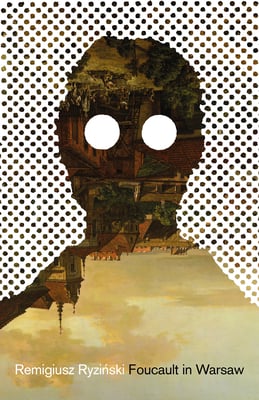

At the time of his death from complications of AIDS in 1984, Michel Foucault was considered one of the 20th century’s most influential intellectuals and philosophers. His work forever changed our understanding of sanity, sexuality, morality, and crime. And yet his life concealed a personal secret that might explain how he first arrived at his profound realizations about society. This secret is finally exposed to light in Foucault in Warsaw – a new book by Remigiusz Ryziński, a writer, gender studies scholar, and professor of philosophy at the University of Warsaw. Nominated for Poland’s most prestigious literary award, Foucault in Warsaw tells its fascinating story through colorful and fast-paced documentary reportage.
Foucault first rose to fame in 1961 with the publication of Madness and Civilization, his first exploration of the way power is exercised in social organizations, or, in other words, how people use visible and invisible means to control other people. The book grew out of Foucault’s doctoral thesis, which he completed in 1958 while heading the Center of French Culture at the University of Warsaw. In Poland, he was welcome, respected, and privileged. Yet the following year, he had to leave it abruptly. Why?
“The reason,” Ryziński states in the opening page of Foucault in Warsaw, “was a certain boy. Jurek. No one figured out who this boy really was.”
It was a rumor, an urban legend, as no direct evidence of the relationship survived either in Poland or in Foucault’s archives in France. Or was it?
It was a rumor, an urban legend, as no direct evidence of the relationship survived either in Poland or in Foucault’s archives in France. Or was it? Ryziński sets out to investigate. And he does it breathtakingly well, finding the answers in a most unexpected source – the archives of the Polish secret police.
The surveyed circles overlapped, as gay men were coerced into spying and reporting on their brethren and foreigners. The informants were being informed on as well.
By default, any foreigner entering Poland or any other Soviet Bloc country in those years was under surveillance. And so were any outed, or simply suspected, local gay men. The surveyed circles overlapped, as gay men were coerced into spying and reporting on their brethren and foreigners. The informants were being informed on as well.
Informing could guarantee a certain level of freedom, protection, and, invaluable in the Communist society, connections to jobs, benefits, and luxury items.
The police dossiers throw back the curtain not only on Foucault’s circle of friends/lovers, but also on the rich and rewarding—though at times perilous—gay life bubbling underground in the Polish capital.
Much of it is intimate. Andrzej D., a typical testimony runs, is
a bisexual who runs a sporting goods shop, meaning he can take the liberty of closing his store every day at about 11 and receive his young lovers during that time. They can then make love in the office on government furniture. Andrzej adores the Roman baths [where the informant met him]. He is very attractive as a man and lover, polite, elegant, and really very kind. Active.
In their thousands of reports, photos, and documents, the police dossiers preserve the lives of hundreds of men, including those who were part of Foucault’s immediate circle, or were close to it. Ryziński then tracks down and interviews some of these men still living in Warsaw. Their lives are an important part of this book, and they put Foucault’s own story in perspective.
So, what was it like to be a homosexual in an Eastern European capital circa 1960?
Foucault in Warsaw takes the reader on a fascinating tour of Warsaw’s cafes, baths, hotels, and private tea parties, where one could meet up with his ‘girlfriends’ and ‘sisters,’ have a meal, a conversation, or an adventure. The city’s streets and public spaces also provided numerous cruising opportunities. Even the Honor Guards of the Tomb of the Unknown Soldier could be entertained for a price – a negligible price for a foreigner like Foucault paid in hard currency.
“The most important supplies,” Ryziński reports, “were vodka and kielbasa. No soldier could resist them. . .. Somewhere in Warsaw there’s at least one photo album with 500 pictures of Honor Guards. Indescribable. How many liters of vodka and kilos of kielbasa did it take to get 500 soldiers?”
Police coercion, even torture, would come and go, but life, the life, continued.
Some of Ryziński’s interviewees today miss the supportive network of ‘girlfriends,’ the directness of the encounters, and even the ever-present danger of entrapment, which augmented the appreciation of what they had. Police coercion, even torture, would come and go, but life, the life, continued.
It is exactly through his exposure to Warsaw’s gay community and its interactions with the state, “the fascinating absurdity of the system,” that Foucault came to understand the mechanisms of power, coercion, and repression. But also, as he would write later, “the human being can always summon the courage to resist and think differently. . . [propelled by] a certain decisive will not to be governed.” Freedom, in other words, will always find new ways to defy control and domination.
The French philosopher discovered freedom, as Foucault in Warsaw documents, in the gay underground of Communist Poland. “Where everything is madness,” concludes Ryziński, “everything is possible.”